SCROLL TO BOTTOM FOR FULL TRANSCRIPT
For the March 2024 Equinox session of ‘Fireside Wisdom with Childless Elderwomen,’ we focused on the topic of caregiving; both the care we give to others, and thinking too about the care we might need ourselves as we age without children…
It’s often the case that childless women are expected to be the ‘natural’ caregivers for vulnerable family members, although our own potential care needs for the future are often hard to talk about or plan for. This is a topic I explored in some depth in my Substack essay ‘It’s not like she’s got anything else to do, is it?‘ which is free to read and the comments section is worth a read too!
Some of us are already caregivers for siblings, parents, partners and others; some of us already receive care.
Many of us are afraid to think about care and caregiving, but we hope this conversation will help all of us to start considering the topic with pragmatic, compassionate and creative depth.
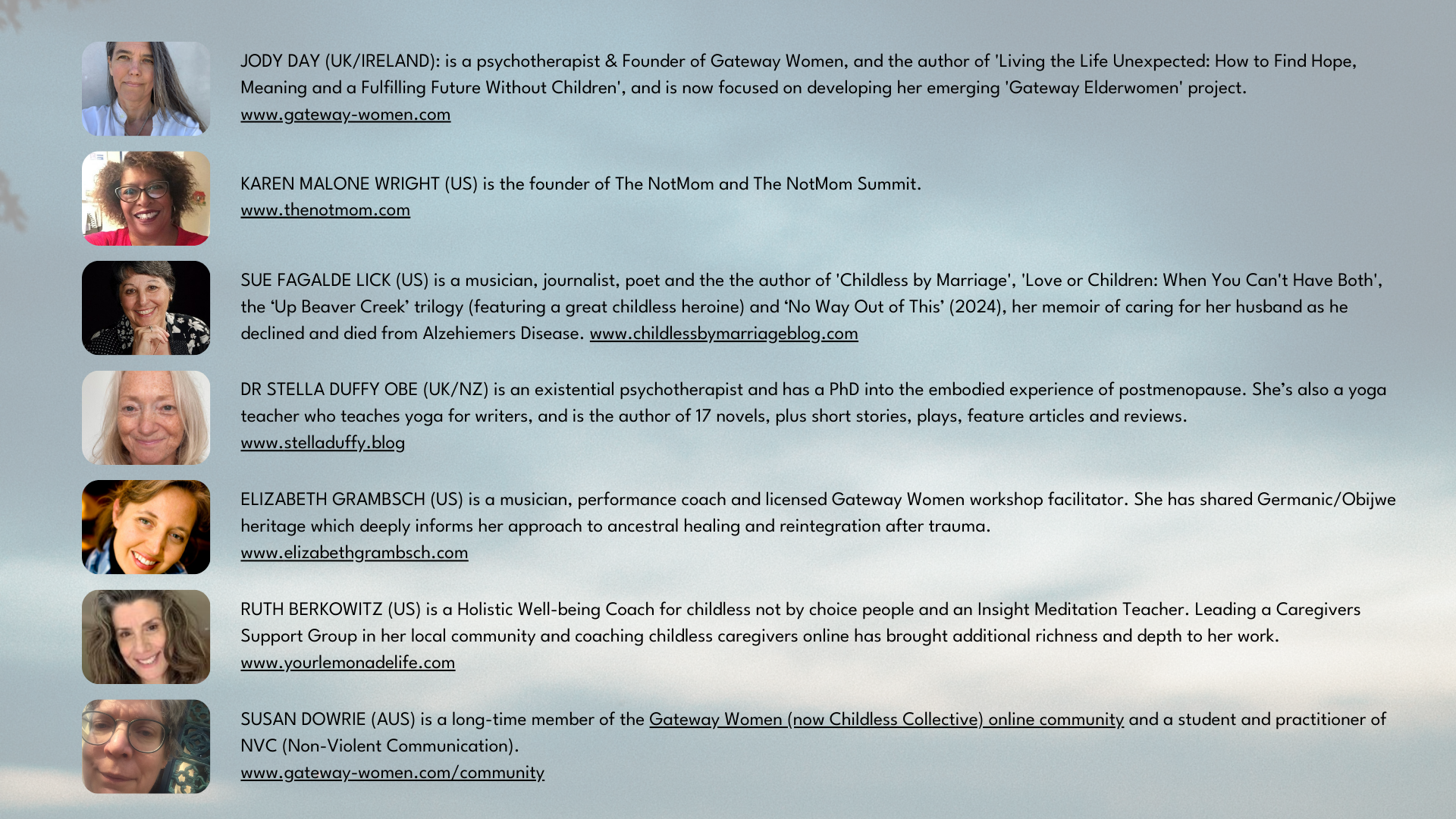
The session was hosted by me, Jody Day and this session's panellists were:
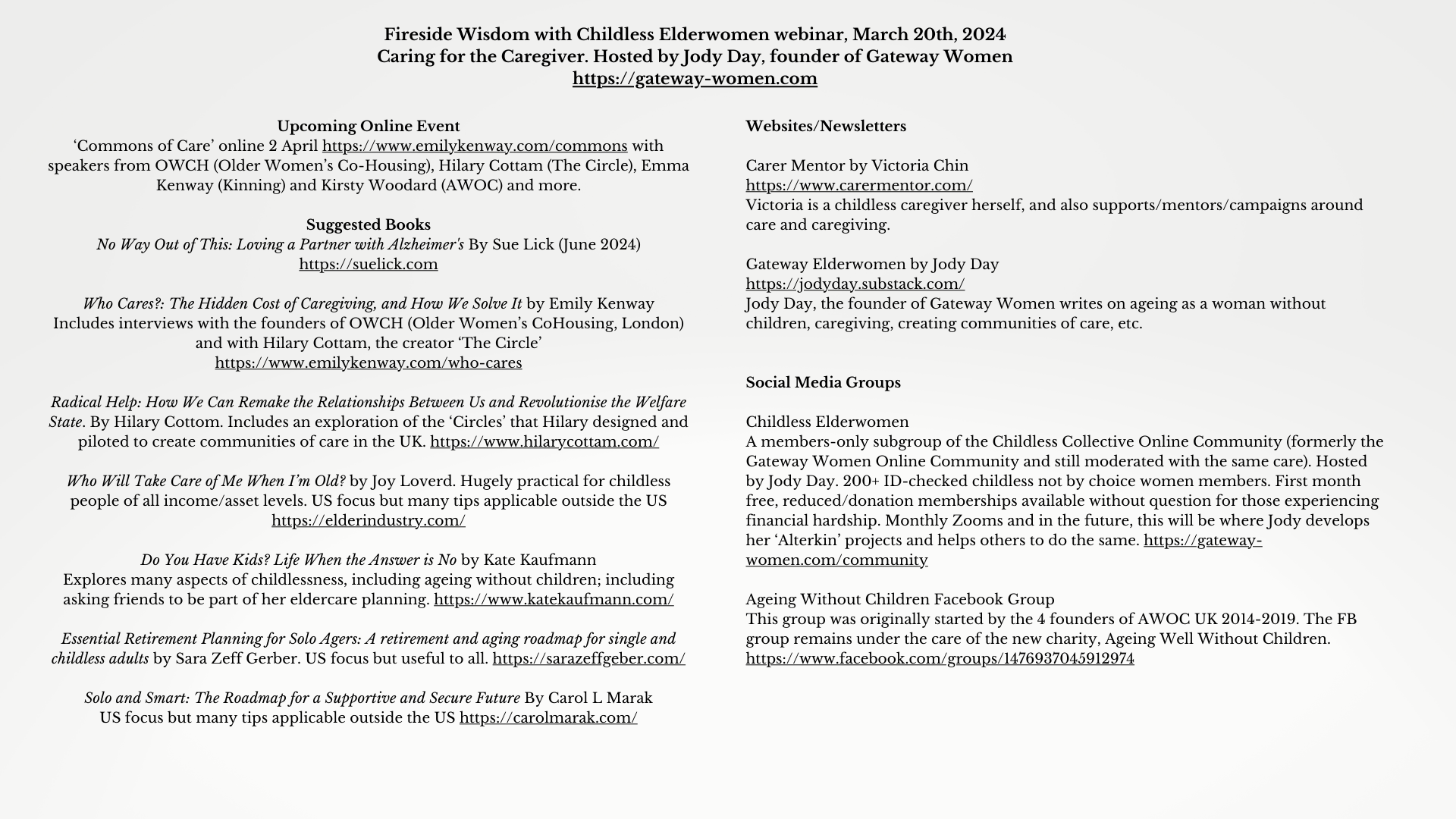
Resources, books, websites, etc mentioned
Find out more about Jody's Gateway Elderwomen project here. Read Jody's essays on Substack, free here. Join Jody's 'Childless Elderwomen' subgroup (hosted by the Childless Collective) here. Watch previous Fireside Wisdom recordings here. Join the Gateway Women newsletter so you don't miss the next Fireside Wisdom call here.
Full Transcript. AI was used to help smooth out vocal transitions, pauses and repetitions, so there may be some errors!
Fireside Wisdom: Caring for the Caregiver
Jody Day 0:04
Hello and welcome to Fireside Wisdom with Childless Elder Women. I’m your host, Jody Day, the founder of Gateway Women, and I’m really happy to bring together this panel of NoMo Crones to discuss caring for the caregiver with you. Now, NoMo Crones — what’s that? NoMo is a word I created — I don’t know, what feels like about a hundred years ago — which means ‘not mother’, and ‘crone’ is not an insult. In fact, once upon a time it used to mean ‘crowned with age’. It’s a term that has become an insult, but actually there’s nothing insulting about being an older woman.
Just Susan Dowrie is with us all the way from shocking o’clock in Brisbane, Australia. And Susan is a long-standing member of the Gateway Women online community, now called the Childless Collective, and a student and practitioner of Non-Violent Communication. If you would like to continue conversations with her, you will always find her in the online community.
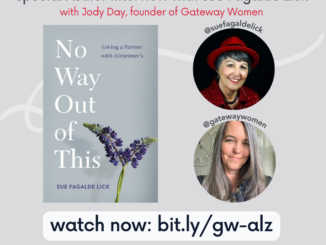
Sue Fagalde Lick is in the US. She is a musician, journalist, poet, and the author of Childless by Marriage, also Love or Children When You Can’t Have Both, the Beaver Creek trilogy featuring a great childless heroine — I really recommend it if you’re looking for a good novel, and there is a trilogy; I always like people who write more than one book. And there is a new book coming out in 2024, a memoir called No Way Out of This, her incredibly poignant account of caring for her husband with Alzheimer’s. It is such an important book.
Then we have Ruth, who is a newcomer to our NoMo Crone conversations today, joining us for the first time, also in the US. Ruth Berkowitz is a holistic wellbeing coach for childless-not-by-choice people and an insight meditation teacher. Leading a caregiver’s support group in her local community, and coaching childless caregivers online, has brought an additional richness and depth to her work. Welcome — lovely to have you with us, Ruth.
And Elizabeth Grambsch, also in the US, is a musician, performance coach and licensed Gateway Women workshop facilitator. She has shared Germanic and Ojibwe heritage, which deeply informs her approach to ancestral healing and reintegration after trauma.
Now, I’ve done a little slide with everyone’s details on, and I’ll include that with the recording so when you receive it, you can find everyone’s details. We’re going to crack on, because it is a huge topic that we decided to tackle: caring for the caregiver. We had 250 questions submitted with the registrations, which grouped into 35 themes, and we’ve chosen a few of them to explore today.
I think we each have a similar lens and yet a different lens on caregiving and care-receiving. Before we dive into the questions, maybe each of us could share a little bit about our own experience of caring, caregiving and care-receiving, just to help viewers position us. We’ve probably got people here who don’t know us.
Just so you know, the last 15 minutes will be a Q&A where you can ask the panellists questions, and that will be anonymous. You type them into the Q&A box at the bottom, and I will moderate those. So, Susan, would you mind sharing a little bit about your caregiving story?
Susan Dowrie 4:07
I’m the second child of four in my family, and the oldest, Jim, was born with a disability, so it’s always been part of my life. I’ve been trained from birth to be aware of the differences and to help Jim through life. I rebelled against that quite decisively through my teenage years and my twenties — I tried to actively do something about it, separating myself — but it’s just not possible. That early training is deep; I cannot walk away from it.
Of course, parents get old and they die. Mum had Alzheimer’s, or some form of dementia, for the last seven or eight years of her life. My two younger siblings and I have been looking after Jim since then.
I am a solo ager, and both my younger siblings are married with children, all now retired. The context is different in Australia because Jim doesn’t actually live with any of us. For some people, that’s where the line is drawn — if you’re not changing bedpans or preparing meals, then you’re not caring. But there is a lot of connecting the dots, and an awful lot of interpreting the world that goes on with Jim. He had a brainstem aneurysm close to 30 years ago, and he has just recently been diagnosed with early-onset Alzheimer’s — probably a direct consequence of that aneurysm.
Jody Day 6:46
Thank you, Susan — thank you for being so open. Sibling caregiving is often hidden, and it’s really lovely to have you. It’s always lovely to have you on these calls. Thank you for getting up so early for us, as ever. Sue Fagalde Lick, can you share a little bit about your story?
Sue Fagalde Lick 7:14
I was first exposed to caregiving with my grandfather, who had a form of dementia — the whole nursing-home journey and all that — though my parents were mostly in charge of that.
My husband had Alzheimer’s. He came down with it at 65 — he was quite a bit older than me — and I cared for him at home for seven years, after which he went into a nursing home, a series of nursing homes, and lived for two more years before he passed. Then only a few years later my father started needing a great deal of care. He lived in California, 700 miles away, so I spent a lot of time travelling back and forth and staying for long stretches, while also trying to manage things long distance.
I would say that even if they don’t live in your house, you are caregiving. You are the one making the calls, making the decisions, ever vigilant that they’re being fed and looked after and have their medications and everything they need. You are caregiving even if you’re not in their house.
I did things hands-on with my dad that a daughter should never have to do — very personal and very hard. He was a very difficult patient; my husband was sweet throughout, but my father was an angry man who could not be pleased, so that was much harder. It’s been a lot of years in caregiving.
Jody Day 9:08
Ruth Berkowitz, could you tell us a little bit about your caring background?
Ruth Berkowitz 9:19
Thank you for having me. My grandmother had ALS and lived with us for a while, but mostly I have been on the other end — the end of needing care, of being vulnerable because of my own health conditions. I had back surgery when I was 24 and have been in chronic pain since then. I’m 52 now. I’ve been on my own for most of my adult life, except for about six or seven years, and I also lived on the opposite coast, in LA, while my family is in Maryland, near Washington DC.
I moved back to the Washington area in 2019, and a lot of that was because I simply couldn’t manage on my own any more. I had a short marriage, and that was helpful in certain ways given my limitations, but once that ended and I was on my own again, it was just too much to cope with without family around.
Today is actually my dad’s 85th birthday, and my parents are still going strong. My mum does some caregiving for me, and they help me live within my limitations so that I can work, volunteer, and do things that are meaningful to me.
As a coach, I also have clients who are caregivers, and I run a caregiver support group every week. These are spouses caring for partners with very long-term illnesses — Parkinson’s, or a severe stroke. Week in, week out, I hear all the ways these spouses show up, and how confronting some of those situations can be, even with strong advocacy.
I have one brother, two years older, who lives locally. We have a very challenging relationship, and I was never really allowed to bond with my niece and nephew. So I carry the awareness that I don’t have family who will be there for me: I don’t expect my brother’s children to be part of my elderhood, and I know I will need to find ways to replace that support once my parents are gone.
Jody Day 12:44
Thank you for your candour and your vulnerability. When I was one of the founding members of AWOC — Ageing Without Children — in the UK, a decade ago, caring for others was often the wake-up call that many of us received about what’s actually involved. As Ruth said, it can be intimate care — feeding and bathing — but there is so much administration, so much joining of the dots, so much emotional and logistical support. Hidden caring is vast when you consider how many of us are, have been, or will be involved in it. In some way, we are all carers. And yet it seems to be another disenfranchised, hidden story — which is why bringing us together to talk about it feels quite precious.
Elizabeth, my darling, can you share a little bit about your story?
Elizabeth Grambsch 14:17
I grew up in an intergenerational household from the age of seven, so my grandparents always lived with us and their ageing was part of our everyday life through into my twenties. I cared for my grandmothers through their cancer for many, many years, and I was with both of them when they died — an incredible, liminal, precious and challenging time. So I had a great deal of experience when I was younger.
More recently, over the past four years, my mother-in-law has recently passed, but before that spent four years in gradual decline, with increasing care needs and increasing attention to all the details I hadn’t had to manage in my twenties: the paperwork was overwhelming — from Medicare to medication management. All that which my parents had handled before, I was now handling.
A couple of years ago I also had a real wake-up call. A colleague — a wonderful gentleman and the founder of the Voice Care Network — single and childless, became very seriously ill during COVID. I stepped in to help. He went into transitional care and I realised he had done no preparation whatsoever: no power of attorney, no healthcare directive, no will — nothing in place. What we went through to pull together a contact list, to connect his different friend groups and professional networks so we could all rally around him — I learned a tremendous amount from that experience about what I need to do to prepare for my own ageing. It was difficult, but very educational.
Jody Day 16:33
Thank you so much. I suppose I should share a little about my own story. I wasn’t really exposed to caring very much growing up. I had a very young mum — she had me when she was 18 — and very young grandparents, but they all died after quite short illnesses. My mum wasn’t close to her family, so I wasn’t around it very much. On my paternal side, my parents split up before I was born and I’ve never had any contact with, or even a photograph of, that side of my family. So it was very much a very small world.
My mum had mental and physical health problems throughout her life, and she developed vascular dementia, probably around the age of 70 — it was definitely showing clearly when she was 71, so it had likely been coming on earlier. My mum died last November in a care home in the UK, and I was with her when she died, which was actually one of the most extraordinary, profound and healing experiences of my life. For those of you who listed caring for narcissistic or difficult parents: I hear you. I did not have an easy mum, and she did not have an easy time being herself, either. There was a very difficult mother-daughter relationship, with its own echoes of her relationship with her own mother.
I live with my second husband in Ireland. His mum, who is 93, has lived with him since before I met him, so since I moved to Ireland five or six years ago we have shared a home and I have become very close to her. She is actually dying at the moment — a very surprising and serious diagnosis of aggressive cancer, and she has only a few weeks to live; that was a few weeks ago now. So we are currently in around-the-clock care. If I have to step away during this conversation should there be a crisis, I will be back as soon as I can, but my partner and I are doing this together.
It’s quite confronting, because she is dying at home, with her son, surrounded by love, with full support and a great deal of peace. And you cannot help but think: none of us is guaranteed something similar.
This topic has come at a very tender time for me. But I think the question of who will be there for us — when we are old, possibly frail — is central. Even people who do have children, when I was involved with AWOC, parents would say, “But I don’t want my children to care for me when I’m old.” And I’d say: I understand that. But what alternative plans are you putting in place so that doesn’t happen? They would usually try to find someone easier to talk to at that point.
Our society has not been structured to make alternative plans easy. And with so many of us now ageing without children — by choice, by chance, or by circumstance — we need to think carefully. You can be a parent and still have children who predecease you, or who have their own adult care needs, or who are on the other side of the world, or from whom you are estranged. The presence of children does not guarantee support.
And it’s not just about intimate care — that’s often where people’s minds go when they have no experience of caregiving. It’s the administration. Even if you have professional carers coming in, someone has to arrange them, let them in, facilitate interactions, pay for them, and keep an eye on the quality of the care. It’s who rings when the iPad gets updated and the online banking stops working. Who sorts things when the boiler breaks, the car needs reinsuring, or the spare tyre has already been used. Who books the dental appointment online and picks you up from hospital after a minor procedure when you’re not allowed to drive.
Because so many of us live far from each other and move around a great deal, and because — as many of us on this call know — being childless not by choice can decimate your friendship group, we may arrive in our 50s and beyond without a solid, deep-rooted peer network. That makes the prospect of ageing without children even more complex.
I do think there are solutions, though they are not easy ones. I believe the solutions that we as childless people create can actually provide a template for what all of us need as we age — whether we have children or not. So much of what we used to do naturally for each other as human beings has been privatised and commodified. But if we can find ways to connect authentically, within boundaried and safe frameworks — which is often precisely why people aren’t doing it — I believe it’s possible. There are pilot studies and fascinating groups already operating in America, the UK, and the Netherlands, and I’m sure in Scandinavia as well.
Because of the time we have, let’s move on. One of the big themes that came up — and I wrote an essay on Substack about it, titled “Well, It’s Not Like She’s Got Anything Else to Do, Is It” — is childless daughters and caregiving. This came up very strongly in your questions.
One of the issues around expectations on childless daughters comes from pronatalism — the idea that as a woman without children, you are not fully occupied as a human being. The assumption is that because you don’t have the financial and other responsibilities of children, you have this vast resource in the middle of your life: energy, money, time, availability. And if you don’t have a partner, even more so. There is no awareness of how unfair that assumption is, or of how it will impact income, health, work, financial security, family and romantic relationships. There is often a sense of: ‘just send her in there’.
It is very difficult to find the language to discuss this between siblings. And often it’s so complicated that childless daughters simply absorb the burden and end up profoundly burnt out, resentful, and sometimes very ill. I’d love to hear from the panel about this. How do we frame those conversations within families? How do we get the support we need? Sue Fagalde Lick, I wonder if you’d like to start.
Sue Fagalde Lick 27:29
I don’t know that I have the answers, but I certainly experienced it — as the daughter and as the one with the more flexible, freelance working life. My brother had, and still has, a very strong nine-to-five. He would come at weekends, take my dad out to lunch, and consider that sufficient. He didn’t do the hands-on work. I was the one who had to upend my life, and there was a significant financial cost — travelling to California and staying for a month, not being able to do my job, bills falling behind because I couldn’t keep on top of them, no sleep, and nobody understanding that I had other things to do besides care for my father.
How do you frame it? I’m not sure anyone truly gets it. How do you sit down and say: you have to help me too? You have to be part of this?
Jody Day 28:39
Perhaps, if we were able to frame it not as selfless caring but as a financial reality — if I don’t do this, how much will it cost you? — that might offer a starting point. People don’t seem to want to understand what the costs to carers are, and it’s so much more than money. But it would help if we could at least begin there. A survey in the UK, which I cited in my Substack article, found an average hit of £12,000 a year to someone’s salary when they take on a caregiving role, and for some people it is a great deal more than that. Why should childless daughters bear a huge financial penalty, on top of the relational, health, and opportunity costs? If you’re a freelancer unable to maintain your network and profile during that time, opportunities simply don’t happen. Sue, you were working during that period as well.
Sue Fagalde Lick 30:00
I held an organ position at a church as well, and I couldn’t fulfil that, and it caused a great deal of disruption every time I had to leave. Nobody understood that.
Elizabeth Grambsch 30:32
I had a really useful conversation — after working with Gateway Women and gathering a lot of information — with my younger brother, who works in wealth management for non-profits. We have three aunts who are also childless, two of them single and never married, and he began to put together ways of helping us as we age. So one piece of positive feedback I would offer: start talking early, give the information to your financial advisers, and let them begin thinking about what’s coming and what can be done.
Trying to talk to our parents about what they would like to happen as they age, on the other hand, has produced no traction whatsoever. They live on the West Coast; my brother is on the East Coast and I’m in the Midwest, and I don’t know how any of this is going to work if they simply won’t discuss it. But at least my brother and I are trying together.
Jody Day 31:41
It’s interesting — 50% of people in the UK and the United States don’t have a will. We are essentially designed to avoid thinking about our own mortality. As far as we know, human beings are the only sentient species aware of their own death, and we have developed many mechanisms to help us not dwell on it. It takes genuine courage and self-awareness to face up to it.
Even getting childless women to complete all their paperwork and put their affairs in order is challenging, because it is emotionally very confronting — it requires us to face, for example, the fact that we may not have an obvious next of kin, or may not know who to ask to hold power of attorney, or to act as executor. Because these things are so confronting, people simply don’t do them.
One of the things we are exploring in the Childless Elder Women group — part of the Childless Collective community — is the idea of ‘buddying up’: having someone sit with us while we tackle these tasks. Not to tell us what to do, just to be present with the overwhelm. Someone who can gently ask: “Did you do the power of attorney today?” And when you say you didn’t get around to it again, they just say: “Okay, let’s try again.”
One of our NoMo Crones, Kate Kaufman, wrote a really interesting book called Do You Have Kids? Life When the Answer Is No, and she has faced up to this very honestly in her own story. When she finally found the courage to reach out to friends and ask them to be her power of attorney, her executor, they were so grateful to be asked. That’s the thing — how do we make ourselves vulnerable enough to ask for support? People like being asked, because it gives them something tangible and deepens the relationship. Something can genuinely shift. But so many of us have internalised this hyper-individualistic Western idea of the lone individual who needs no support, which is absolutely not who we are. We are an interdependent species. If we don’t ask anyone, that may indeed be how it turns out.
Susan Dowrie 35:48
My brother Jim has been a great model to me. He has always been dealing with this — there is no ‘before’ for him to regret. It just is what it is. And his ability to take things one day at a time, to live in the present — that’s something so many of us had as children but have lost as adults. He still has it: ‘Let’s just do today. Don’t rush. One step at a time.’
And there is also a deep trust in him — proven over and over — that when you are out in the world and appear to need help, people will offer it. Your job is simply to say whether the help they’re offering is what you’d like to receive, or to shape it into something that would be genuinely welcome — and in doing so, to create a genuine connection of care, given and received.
One of the challenges for many of us, perhaps, is that our care needs may not be visible. And that makes a real difference — whether a disability or need is visible or invisible, permanent or temporary, singular or multiple.
Jody Day 37:46
That makes such a difference, which is why having a community around you that gets to know you is so important. Creating communities of care — what I call alta kin, a word I coined at AWOC standing for Alternative Kinship Network — is going to be the work of the next decade of my life: fleshing that out, running pilot studies, and supporting others to do similar things around the world.
Elizabeth Grambsch 38:15
I wanted to add something to what you said about asking people to take on an important role in your care. If you’re not asked — or if you’re not willing to ask — it can damage the relationship. When my friend and colleague wasn’t willing to ask for help formally, it put an enormous burden on those around him. His car ended up in the pound because, without power of attorney, I couldn’t get it out; I couldn’t access his bank account to pay for it. I was having to cancel appointment after appointment, losing so much of my time, until I began to feel: this is really not all right — this is harming me. It put a real strain on our relationship that he couldn’t make that leap. We genuinely need the courage to make it, because not doing so puts people in a very difficult position.
Ruth Berkowitz 39:27
I was just speaking with someone who holds power of attorney for a friend, and he mentioned the importance of having separate powers of attorney for financial and medical matters, because of potential conflicts of interest. Someone in the chat also mentioned that while she had little difficulty finding someone for the financial side, she struggled to find someone willing to take on the healthcare one.
Jody Day 40:01
I’m about to revise all of mine. One of the challenges, of course, is that as we age, we want someone younger than us — but our close friends are ageing alongside us. And many of us don’t have easy access to meaningful relationships with the next generation. Families are getting smaller; siblings may not have children, or those children may live on the other side of the world. Estrangement happens.
I don’t have siblings, but I do have close relationships with a few of my nieces from my first marriage — I call them nieces by love, not blood — and that feels very tender and very precious. Their mother helped me enormously by facilitating those relationships. She was not threatened by my childlessness; she did not keep me at a distance from her four daughters. Being welcomed into a family matters greatly.
And if you are a stepmother — I’m thinking of you, Sue — having been a childless stepmother doesn’t necessarily mean you have a replacement family around you in later life. The bonds may not be strong enough, or they may be far away, for any number of reasons.
Now, I’ve created a fact sheet — I now feel rather like a Blue Peter presenter, which really does date me — with books and resources I recommend, including Who Cares? The Hidden Crisis of Caregiving and How We Solve It by Emma Kenway, which has just come out in paperback in the UK. I cannot recommend it highly enough. Emma Kenway also has an online event on the 2nd of April where she will be talking about what she calls the commons of care, and Kirsty Woodard — one of the original founders of AWOC — and Hillary Cotton, author of Radical Help, will also be appearing. There is a great deal more on the fact sheet as well.
So, back to the Q&A. Here is one question: “I care for my elderly parents — my dad is 97 and my mum is 80 with vascular dementia. I don’t know how to say no or put my needs first. There’s such a pull towards them, and I often think it’s a privilege, and I should do what I can while I can. How do I find balance and prevent carer burnout?” Carer burnout, self-care, and boundaries were probably the two biggest themes in the submitted questions. Who would like to speak to this?
Ruth Berkowitz 43:52
I’d like to offer a framework for tracking how you’re doing — and that is to think across four dimensions: physical, mental, emotional, and spiritual wellbeing. How are you looking after your body? What are your thoughts and judgements — are guilt and shame present? On the emotional spectrum, is there any space for you beyond your role as a carer, or do you feel, as someone in my group said recently, like you’ve reached a dead end? And spiritually: are you finding meaning in your life beyond the caring role? And throughout all of this, can you hold compassion for yourself?
Jody Day 45:28
Thank you, Ruth. Feeding the spiritual life is so important. Something else that came up in people’s questions — some of them weren’t really questions so much as statements about where they were, which was deeply moving — is the way in which the identity of being a carer can function rather like work: something we collapse our sense of self into and find meaning and purpose within, something we can over-invest in and lose our boundaries around. And then when the caring role is no longer needed — perhaps when that person dies — our identity can become very fragile indeed. How do we then rebuild, as a childless woman who is no longer a carer? Sue, I suspect this is something you really relate to.
Sue Fagalde Lick 46:28
It is different with parents than with a spouse, but in both cases you have to — and I know ‘boundaries’ has become such a buzzword — but you have to set boundaries and say: I will give up this, but I will not give up that. I cannot give away this part of myself and be any good to any of us. Whatever it is: I will be here for a week, but I can’t stay longer.
When my husband went into the nursing home, I was much more able to relate to him with love, as his wife, rather than as his nurse, carer and administrator, because some of that burden was being carried by others. I can love you better if you’ll let me help you in this other way.
There are things you have to keep hold of. I gave up my church organist position — I hated having to do that — but I would never give up my writing. That was non-negotiable. Whatever it is for you: ‘I’m still going to church on Sundays, and someone else will have to step in during that time.’ You have to keep parts of yourself, no matter what.
Elizabeth Grambsch 47:50
I worked with an end-of-life doula and was fortunate to find someone who was herself childless. She was incredible. She helped me think about what time I needed to carve out for myself, and she found resources for my husband, who was caring for his mother — he went to a carers’ group and got his own needs met, and I got space. She was also able to say to my husband, very gently: “Marcus, it’s time for you to let go of being her carer and just be her son.” I think that was a wonderful gift we gave ourselves — an end-of-life doula to support those decisions, because you lose perspective entirely when you’re in the middle of it.
Susan Dowrie 48:42
That doula took an advocacy role for the caregiver in that situation. If you can find such a person, that is gold — even if they’re not actively in the situation day-to-day, but are simply prepared to hear you about it.
If you don’t have that, you can work with what you have — even the anger or frustration, which is a very raw form of it. Sit with it. Feel what’s behind it. What is the love at the heart of that anger? Not just what you want to stop, but what you yearn for — what would be better in a situation you probably did not choose and cannot really control.
For me, that has meant choosing to do less in person, and to let the practical tasks go more. Stepping back from task-based support, but stepping up on emotional support — partly because I’ll be travelling, and I can do that over the telephone.
Jody Day 50:11
Something that has come up in the Q&A too: a lot of people are carrying very difficult feelings — resentment, guilt, bitterness, anger, dark thoughts. Sarah Roberts, a Gateway Women facilitator from Brisbane who is well known to many of us, has said something I want to share: ‘It’s OK to feel difficult feelings — anger, resentment — when we care for those who may never have cared for or attended to us when we needed it.’ Including around our childlessness.
My own childlessness was never really held, tended to, or understood by my mum. My mother-in-law has tried — she doesn’t fully get it, but she’s given it a go — and I’m in a good enough place with my childlessness that I don’t need that from her now. But I think it’s really important to affirm: there are no wrong feelings. Every feeling is useful. I love what Susan said about the purity of feelings.
If you are solo — without a partner, without a support system around you — the emotional, spiritual and psychological burden of caring is intense. Your own needs are not being prioritised or cared for. This can become a real moral injury. We need to put on our own oxygen mask: attend a caregiver’s support group. There are some wonderful ones online. Carers UK, mentioned in the chat, is an excellent organisation, and many countries have both online and local groups for carers.
With our ageing population and falling birth rates, the ratio of people available to care versus people who may need care is becoming quite acute. Governments cannot afford to solve this, even if they had the will to try. The pressure on carers is going to increase, and we need to be advocating for ourselves and our needs.
Susan Dowrie 52:53
Being a carer is a recognised role — it gives us social currency, but it also puts us in a bind. People would focus on what I was doing for Jim as though that were my whole life, validating me through that role: ‘Oh yes, you’re a valid person — you’re doing a caring role.’ I’ve stopped telling people what I do for Jim, partly to resist having that become my identity.
Sarah Payton, whose work I engage with a great deal, talks about what she calls ‘moral beauty’ — one of eight sources of awe: other people’s kindness, courage, and purity of intention. I’ve had that applied to me too: ‘Your parents would be so proud to see how Jim’s siblings support him.’ And there’s no space in that framing to say: actually, this is really hard. It keeps interrupting my life. It’s exhausting. I have no control over it and it will never end.
Just being aware of those patterns, so you can speak back to them with kindness — finding the language for it — is really important.
Jody Day 55:00
Naming things and recognising patterns — how people frame us, the boxes they want to put us in — and finding a way to say: no, that’s not my box. That has been such an important part of my own journey, and of the work of the last thirteen years.
We are running out of time, and we could just keep going. I do have a list of resources — books and websites — both for those who are currently caring for others and for those thinking about their own care needs as they age. There are no easy solutions, but what we can do is build communities of care. We can come together to support each other, and we can create intentional communities of care. One of the challenges is that they have to exist in real life. Online communities are wonderful, but we are going to have to bring this into our local areas. I plan to be doing that over the next few years, and supporting others to do the same. It is possible, but it needs to be intentional, it needs to be vulnerable, and it needs to be boundaried. There are real reasons we haven’t all rushed out to do it — if it were easy, we would have done it already.
In a sense, we are going against the grain of the culture. But underneath that, there is a much older culture of care between us as a species — one we can draw on. Before the nuclear family, before globalisation, before capitalism, we cared for each other because there was no alternative. It wasn’t always perfect, and I don’t want to romanticise the past — there is no perfect solution to being human. But the foundations are there.
Thank you so much for being here. The Gateway Women online community, now called the Childless Collective, is a wonderful way to connect with childless people from across the world. The World Childless Week website also lists other childless communities, so the Childless Collective is not the only one — other options are available — but I recommend the one I founded, which Katie has continued with such beauty and grace, and for which I am so grateful.
Thank you so much to Susan Dowrie for getting up so early in Brisbane; to Sue on the West Coast of America in Oregon; to Ruth on the East Coast; and to Elizabeth in the Midwest. Apart from me — essentially the sole European representative on the call, along with Pushkin — we will be back in June for the next edition. Thank you all so very much. This is just the beginning of a really, really important conversation.